House one
InverterGOLD heat pump
 GOLD · R290
12.31kW of heat
15.0°
Area 100 m²Energy cost so far0new SYP
Electricity used0.0kWh
Electrical input now3.04kW
 Gold LabGOLD GROUP · HEATING & COOLINGPrice reference · 06 September 2026
An educational energy-cost estimate with an assumed 16 kW heat output limit and constant conditions. COP and boiler efficiency are adjustable; results are not guaranteed savings or a substitute for project design.
GOLD · R290Changing an input resets the clock and recalculates the comparison.
Household: 6 new SYP/kWh for the first 300 kWh of a two-month billing cycle, then 14. Enter the allowance left for heating after other household consumption. The default assumes no first-tier allowance remains. All 30 days fall in one billing cycle, without an allowance reset.
Design heat load is referenced to 21°C indoors and −5°C outdoors. Thermal capacity is an assumption for the building and its contents. An illustrative 3-hour response controls the approach to target temperature. Available heat output is assumed fixed at 16 kW; actual sizing must use the unit’s capacity and COP at the relevant air and water temperatures.
Days · The vertical line marks current time; both curves show the full projection.
Hours · Illustrative building response; not a compressor test map.
The heat pump transfers energy from air to water. A boiler converts fuel energy into heat.
Warm-up can require extra heat. As the house stabilizes, output approaches its heat loss. The curve illustrates load-following control, not a measured compressor performance map.
Thermal storage and insulation can reduce cycling and support stable flow. No separate buffer saving is added to the calculation; its benefit depends on sizing, connections and controls.
The starting COP of 4.05 references GOLD’s 16 kW model at 7°C air and 35°C supply water. When weather changes, COP remains your explicit input; it does not adjust automatically.
Heat loss is calculated from floor area, design heat load and temperature difference. Both houses receive equal useful heat each minute, converted to electricity or diesel through these equations:
Q is useful heat in kWh; η is boiler efficiency as a decimal. The default 80% is an adjustable overall operating assumption, not a specification of a particular boiler. Approximate diesel heat content uses a higher heating value (HHV) basis; efficiency must use the same basis, not an LHV-rated value.
UA is in kW/K and C in kWh/K. The time step is one minute. The illustrative controller requests heat-loss replacement plus a 3-hour response toward the target, capped between zero and 16 kW.
Incremental household cost charges the available first-tier allowance at 6, then 14 for the remainder. The full two-month allowance is not assumed available for heating.
The comparison assumes grid electricity and diesel remain available throughout. Backup electricity during rationing, external pump consumption and distribution losses are not included; they must be added for a detailed project assessment.
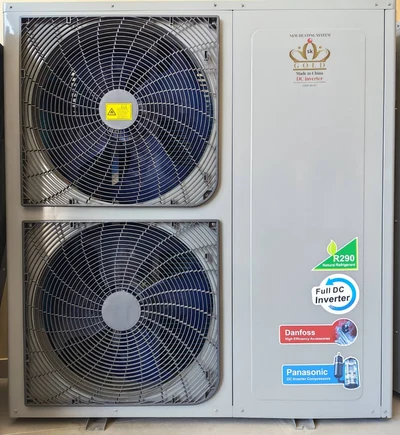
Product reference: GOLD’s supplied seminar catalog, R290 16 kW model; 16 kW heating, 3.95 kW input and COP 4.05 at A7/6 · W30/35. The photo shows the actual GOLD cabinet shared by the 16 and 22 kW models according to the company.
Inverter and buffer benefits are not added as separate discounts. Response time and thermal capacity are educational assumptions. Outdoor temperature changes building load; choosing COP requires a relevant performance source or engineering estimate.
Solar and internal heat gains are omitted and outdoor temperature is constant for 720 hours. The diesel boiler follows the same delivered heat, with the same 16 kW limit; actual burner cycling is not modeled. The limit is not a guaranteed unit capacity in every weather condition.
Price reference as of 6 September 2026. The diesel rate is dated 4 September, reported from the pricing committee in the linked coverage. Update it when a newer bulletin is issued. These energy-use estimates are not a binding quotation.